Every March, Bradford pear trees explode into white blossoms across Charlotte. Entire streets turn white almost overnight. The flowers look beautiful from a car window. Up close, they smell like rotting fish. That smell — a sharp, sour odor that carries on warm breezes — is the first hint that Bradford pears are not the ornamental gift they were marketed as.
Bradford pear (Pyrus calleryana 'Bradford') was one of the most planted landscape trees in the American South from the 1970s through the early 2000s. Charlotte developers put them everywhere — along boulevards, in parking lot islands, in front yards of new subdivisions from Ballantyne to Huntersville. They were cheap, they grew fast, they had showy spring flowers and decent fall color. They looked like the perfect ornamental tree.
They are not. And Charlotte is finally catching on.
The Structural Problem
The single biggest issue with Bradford pears is their branch structure. The tree grows in a tight, upright form — all the major limbs emerge from the trunk at narrow angles, often from nearly the same point. Arborists call these "included bark" attachments. Instead of the branch sitting securely in a wide crotch, the bark of the branch and the bark of the trunk grow pressed against each other with no real wood connection between them.
The result is a tree that essentially bolts itself together with bark instead of wood. When the tree is young and the branches are light, this holds fine. But Bradford pears grow fast — 3 to 4 feet per year — and the canopy fills out quickly. By the time the tree is 15 to 20 years old, those narrow branch attachments are carrying hundreds of pounds of foliage and wood. And they start to fail.
Ice storms are the worst. Charlotte gets one or two ice events every few years, and Bradford pears fall apart during every single one. The tight branch angles collect ice, the weight builds, and the branches peel apart from the trunk like a banana splitting open. A single ice storm can destroy a Bradford pear that looked perfectly healthy the day before.
Summer thunderstorms do the same thing. High winds push the dense canopy, and the weak branch unions give way. It is common to see Bradford pears split right down the middle after a July storm — half the tree on the ground, the other half standing with a raw, exposed trunk.
This is not just an aesthetic problem. When large Bradford pear branches fail, they land on cars, fences, roofs, power lines, and people. Tree removal companies in Charlotte get a wave of Bradford pear calls after every significant weather event.
The Invasive Problem
When Bradford pear was introduced, breeders believed it was sterile — unable to produce viable seeds. That turned out to be wrong. Bradford pear cannot pollinate itself, but it can cross-pollinate with other Callery pear cultivars (Cleveland Select, Aristocrat, Chanticleer, and others). Charlotte landscapes are full of these different cultivars, and bees move pollen between them freely.
The resulting fruit — small, hard berries that birds eat and spread — grows into wild Callery pear trees. These wild offspring are nothing like the tidy ornamental their parents were bred to be. They are thorny, weedy, fast-growing, and aggressive. The thorns on wild Callery pear can be 3 to 4 inches long — long enough to puncture a tire.
Drive along I-85 or I-77 through the Charlotte area in early spring and look at the tree line. Those white-flowering trees taking over the roadsides and field edges are wild Callery pear. They are in the greenways, in vacant lots, at the edges of parking lots, and in parks. They crowd out native trees like dogwood, redbud, and serviceberry.
North Carolina added Callery pear to its invasive species watch list. South Carolina went further — banning the sale of Bradford pear and all Callery pear cultivars entirely, starting in 2024. North Carolina has not passed a sales ban yet, but many nurseries in the Charlotte area have voluntarily stopped selling them.
The Lifespan Problem
Bradford pears are short-lived trees. Most start falling apart at 20 to 25 years old. Some last 30 years if they avoid major storms. Compare that to a white oak (200+ years), a willow oak (80 to 100 years), or even a red maple (60 to 80 years).
Charlotte is now hitting the age window where Bradford pears planted during the building booms of the 1990s and early 2000s are reaching the end of their useful life. They are splitting, dropping limbs, and looking ragged. The tree that gave a new subdivision instant curb appeal 25 years ago is now a liability. Many neighborhoods are removing them block by block.
Charlotte's Tree Ordinance and Bradford Pears
Charlotte's tree ordinance requires permits for removing trees over a certain size on residential property. Bradford pears are not exempt from this — you still need to follow the permit process. However, most arborists and city planners understand why Bradford pears are being removed, and permits for their removal are generally approved without difficulty, especially when the tree shows structural problems.
If your Bradford pear has already split or lost major branches, it may qualify as a hazard tree, which can speed up the permit process. An estimate from a tree removal company that documents the structural defects helps with the application.
What Removal Looks Like
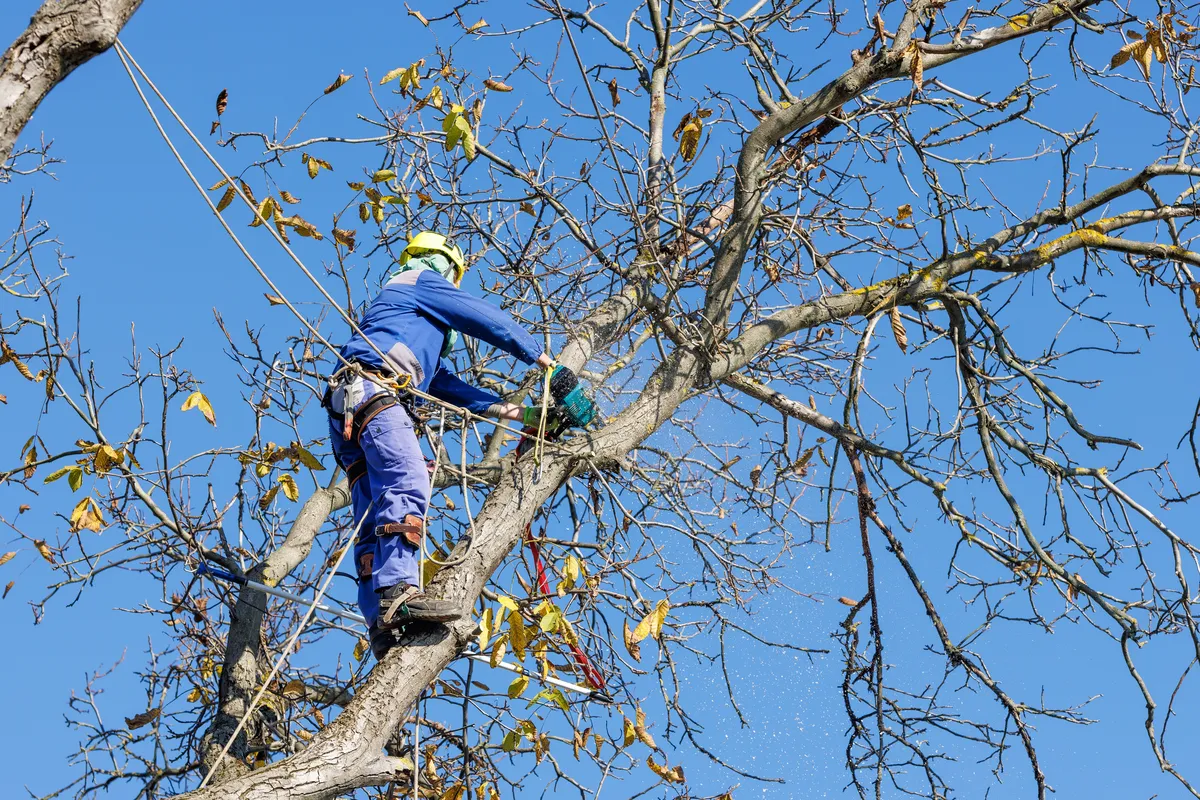
Bradford pear removal is usually a quick job for a tree service crew. The trees rarely exceed 40 feet tall, and the wood is light compared to hardwoods. A crew can typically remove a Bradford pear in half a day, including cleanup.
Cost for Bradford pear removal in Charlotte runs $400 to $1,500 depending on size, location, and whether the tree has already partially split (which can actually make removal more complicated since the tree is unstable). Stump grinding adds $100 to $300.
If the tree has already split and part of it is leaning on a structure or fence, expect the price to be on the higher end. Working around a partially failed tree requires more care and more equipment.
The Smell
It deserves its own section. Bradford pear flowers contain trimethylamine, the same chemical compound found in rotting fish. The smell is noticeable from 50 feet away on a warm day. It lasts about two weeks during peak bloom, usually in late February through mid-March in Charlotte.
If you have outdoor seating areas, a pool, or you just like to have your windows open in early spring, a Bradford pear in full bloom nearby makes that unpleasant. The smell is strong enough that some Charlotte restaurants with outdoor patios have requested that adjacent property owners remove their Bradford pears.
What to Plant Instead
The good news is that there are many better trees for Charlotte yards that fill the same niche — moderate size, spring flowers, fall color, and fast growth. Here are the best alternatives:
Yoshino cherry (Prunus x yedoensis). White to pale pink spring flowers without the smell. Grows 25 to 35 feet tall. Moderate growth rate. Good branch structure. Lives 30 to 40 years — longer than Bradford pear — and ages more gracefully.
Eastern redbud (Cercis canadensis). Native to the Charlotte region. Purple-pink flowers in early spring before the leaves emerge. Small tree, reaching 20 to 30 feet. Excellent in partial shade. No invasive tendencies.
Serviceberry (Amelanchier spp.). White spring flowers, edible berries, excellent fall color. Grows 15 to 25 feet. Multi-stemmed or single trunk forms available. Native and wildlife-friendly.
Chinese pistache (Pistacia chinensis). One of the best fall color trees for the Southeast. Orange and red leaves in November. No messy fruit on male trees. Grows 30 to 40 feet with a broad, rounded canopy and strong branch structure.
For a full list of alternatives, see our best shade trees for Charlotte guide.
Should You Remove Yours Now or Wait?
If your Bradford pear is still in one piece and looks healthy, you might be tempted to keep it until it becomes a problem. That is understandable, but there are a few things to consider.
First, Bradford pears do not give much warning before they fail. A tree that looks fine on Tuesday can split in half during a Wednesday afternoon thunderstorm. The structural weakness is internal — you cannot see included bark from the outside without an experienced eye.
Second, every year your Bradford pear flowers, it contributes to the invasive Callery pear problem. The cross-pollinated seeds from your tree end up in greenways, roadsides, and your neighbors' properties.
Third, the younger replacement tree you plant now needs time to grow. If you remove the Bradford pear today and plant a cherry, redbud, or pistache, that replacement tree has a head start on becoming the established shade tree your yard needs in five to ten years. If you wait until the Bradford pear fails in a storm, you are starting from scratch with a new tree while also paying emergency removal rates.
Most arborists in Charlotte will tell you the same thing: do not wait for the storm. Remove it on your schedule, plant something better, and skip the emergency.
The Bigger Picture
Bradford pear's fall from grace is one of the clearest examples of why planting the right tree matters. A tree that was the darling of landscapers for 30 years turned out to be structurally weak, ecologically harmful, and short-lived. Charlotte planted thousands of them. Now Charlotte is removing thousands of them.
The lesson is worth remembering the next time you plant a tree. Choose species that are strong-wooded, long-lived, well-adapted to the Piedmont, and native or non-invasive. The tree you plant today will be shading your property — or your buyer's property — for decades. Pick one that will still be an asset in 50 years, not a problem in 20.
Need a Bradford Pear Removed?
Get a free quote from experienced Charlotte tree service companies. Replace your Bradford pear with a stronger, longer-lived tree.
Get a Free Quote