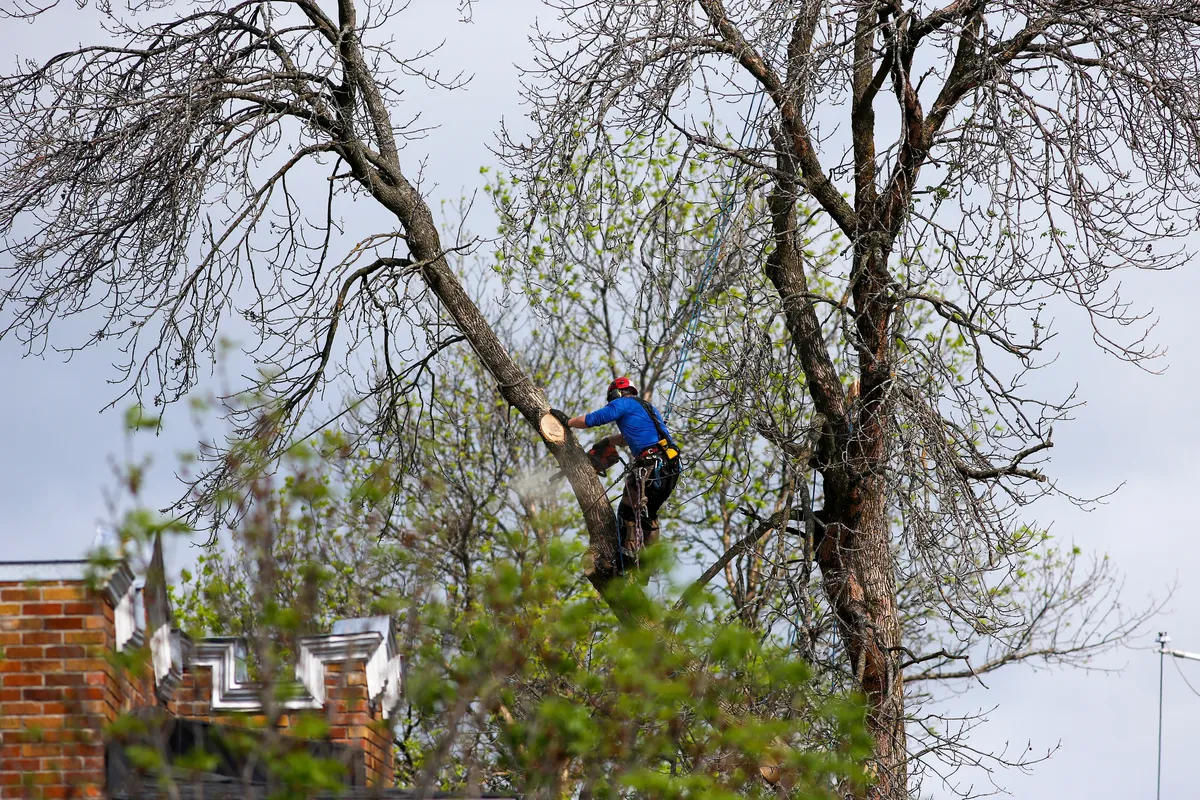
You are looking at a tree in your yard and something seems off. Maybe the leaves did not come in this spring. Maybe the bark is peeling away in sheets. Maybe mushrooms appeared at the base overnight. You are wondering: is this tree dead? Is it dying? And is it about to fall on my house?
These are good questions to ask, and asking them early can save you from an emergency situation later. A dead tree standing next to a Charlotte home is not a matter of "if" it will come down, but "when." Storms, wind, and even a heavy ice coating can bring a dead tree crashing into your roof, your car, or your neighbor's yard. Here is how to tell if a tree on your property is dead or dying, and what to do about it.
The Scratch Test: The Simplest Check
The scratch test is the fastest way to determine if a tree or branch is still alive. Here is how it works:
- Pick a small branch or twig at the end of a limb, roughly pencil-thickness.
- Use your thumbnail, a pocket knife, or a key to scratch through the outer bark.
- Look at what is underneath.
If you see green: That branch is alive. The green layer is called the cambium, and it is the living tissue just under the bark. A healthy tree will show bright green, moist tissue beneath the bark surface.
If you see brown or gray, dry tissue: That branch is dead. Try the test on a few different branches around the tree. If every branch you test comes back brown and dry, the tree is very likely dead.
The scratch test is not foolproof. A tree can be dying from the inside out (from root disease or internal decay) and still show green cambium on outer branches for a while. But it is a solid first indicator that any homeowner can do in two minutes.
Visual Signs a Tree Is Dead
You do not need to be an arborist to spot most of the warning signs. Walk around the tree and look for these indicators:
No Leaves When Other Trees Have Them
This is the most obvious sign for deciduous trees (oaks, maples, dogwoods, sweetgums). If it is May in Charlotte and every other tree on your street has leafed out but yours is still bare, that tree is either dead or in serious trouble. Charlotte's growing season starts in March and April, and by mid-May, every healthy deciduous tree should be fully leafed out.
One caveat: some trees leaf out later than others. Red maples in Charlotte push leaves early, sometimes by late February. White oaks and hickories can take until mid-April. Know what species your tree is before you panic.
Bark Falling Off in Large Sections
Healthy trees shed small pieces of bark as they grow. That is normal. But if bark is peeling away in large sheets or chunks, exposing bare wood underneath, the tree is dying or already dead. Once the cambium layer dries out and the bark detaches, the tree cannot transport water and nutrients. It is done.
This is common on dead pine trees in Charlotte. Loblolly pines will hold their bark for a while after dying, but eventually the bark plates start separating and falling off in chunks. By that point, the tree has been dead for months.
Mushrooms and Fungal Growth at the Base
Mushrooms growing at the base of a tree or on the trunk itself are a sign of internal decay. The mushrooms you see on the outside are just the fruiting bodies. The real organism, a network of fungal threads, is inside the wood, breaking it down from within.
In Charlotte's warm, humid climate (summer humidity regularly sits above 80 percent), fungal growth is common. Look for:
- Shelf fungi (conks): These are the hard, shelf-shaped growths that stick out from the trunk like a bracket. They indicate advanced internal decay.
- Mushroom clusters at the base: Often a sign of root rot, which is a death sentence for most trees.
- White or yellow fungal mats under peeling bark: A sign the tree is being consumed from the outside in.
Major Dead Branches in the Canopy
Look up into the canopy during the growing season. Dead branches are easy to spot: they have no leaves, the bark may be missing, and smaller twigs will be brittle and snapping off. A few dead branches in an otherwise healthy canopy is normal, especially in older trees. But if more than 25 to 30 percent of the canopy is dead wood, the tree is in serious decline.
Trees often die from the top down. The top of the canopy loses its leaves first, then the die-off spreads downward over a few seasons. This is called "dieback" and it is a very clear sign that a tree is not going to recover.
Leaning or Shifting
Many trees grow with a natural lean. That is usually fine if the lean has been there since the tree was young and the root system developed to compensate for it. What is dangerous is a new lean, where a tree that was standing straight starts tilting. This often means the root system is failing.
Look at the soil around the base. Do you see cracked or heaving ground on one side? Are roots lifting out of the soil? These are signs that the tree's anchor system is giving way. A tree with a new lean and visible root disturbance needs immediate professional assessment. For more detail, read our article on when a leaning tree is dangerous.
Cavities and Holes in the Trunk
Holes in the trunk, whether from woodpeckers, old branch failures, or disease, are entry points for decay. A single small cavity is not necessarily a crisis. But a large cavity, or multiple cavities, means the trunk is losing structural wood. At some point, the remaining sound wood is not enough to support the weight of the canopy, and the tree fails.
Woodpecker activity is especially worth watching. Woodpeckers drill into trees to eat insects that live in dead or decaying wood. A lot of woodpecker holes concentrated in one area means there is a lot of dead wood in that part of the tree.
Common Causes of Tree Death in Charlotte
Understanding why trees die in the Charlotte area can help you spot problems early and potentially save a tree before it is too late.
Drought Stress
Charlotte averages about 43 inches of rain per year, which sounds like plenty. But that rain is not evenly distributed. Summer dry spells are common, and some years we get extended droughts that stretch from July into October. During the 2007 drought, Mecklenburg County saw widespread tree decline that killed thousands of trees over the following two to three years.
Trees stressed by drought are more vulnerable to insect attack and disease. A mature tree might survive one bad drought but die slowly if it faces two or three drought years in a row. Watering mature trees during extended dry spells, especially newly planted or young trees, can prevent a lot of loss.
Construction Damage
This is one of the biggest tree killers in the Charlotte metro area, and it often does not show up for two to five years after the damage is done. When construction equipment drives over a tree's root zone, compacts the soil, or cuts roots to dig foundations and utilities, the tree looks fine for a while. Then it slowly declines because its root system can no longer support it.
Charlotte is growing fast, with new construction in neighborhoods across Ballantyne, the Lake Norman corridor, and the southeast suburbs around Weddington and Marvin. Trees on lots adjacent to new construction often suffer root damage even when the builder tries to protect them. If you notice a tree declining within a few years of nearby construction, root damage is the likely cause. See our article on tree preservation during construction for prevention tips.
Disease
Charlotte's warm, humid climate is excellent for tree diseases. Some of the most common ones that kill trees in the area include:
- Bacterial leaf scorch: Kills oaks and elms slowly over several years. Leaves brown at the edges and drop early in summer.
- Hypoxylon canker: Attacks stressed oaks. You will see a black, crusty coating on the bark. By the time it is visible, the tree is usually beyond saving.
- Armillaria root rot: A soil-borne fungus that attacks many species. Mushrooms at the base of the tree are a hallmark sign.
- Thousand cankers disease: Affects black walnuts. Caused by a combination of a bark beetle and a fungus.
For a deeper look at what is attacking trees in the Charlotte area, read our full guide on common tree diseases in Charlotte.
Storm Damage
Sometimes a tree does not die right away from storm damage. A lightning strike, a major limb break, or a partial uprooting can weaken a tree enough that it declines over months or years. The wound from a large broken limb becomes an entry point for decay. A partially uprooted tree may limp along for a season or two before the compromised root system finally gives out.
Old Age
Every tree has a lifespan. Bradford pears last about 20 to 25 years before they start failing. Loblolly pines can live 100 years or more but are often in decline by 50 to 60 years. White oaks can live for centuries if conditions are right. If your tree is approaching the end of its natural lifespan for its species, decline is expected, not preventable.
When a Dead Tree Becomes Dangerous
A dead tree is not automatically an emergency. A small dead dogwood in the middle of a large yard, far from any structures, is a low priority. But a dead tree becomes a hazard when:
- It is within falling distance of your house, your neighbor's house, a shed, or a fence
- It overhangs a driveway, walkway, or area where people spend time
- It is near power lines
- It is large enough that falling branches could cause injury or damage
- The trunk shows signs of decay, cavities, or cracks that suggest it could fail in a storm
Dead trees lose their structural strength quickly. The wood dries out, decay organisms move in, and within a year or two, a dead tree that looks solid can be rotten inside. Charlotte's storms do not wait for you to get around to removing a dead tree. After every major storm, tree service companies in Charlotte pull dead trees off houses that the homeowner had been "meaning to take care of."
What to Do If You Find a Dead or Dying Tree
If you have identified a tree on your property that appears dead or is showing serious decline, here are your next steps:
- Get a professional assessment. An arborist or experienced tree service company can confirm whether the tree is dead, diagnose the cause, and tell you whether it can be saved. If the tree is simply stressed (from drought, for example), treatment may bring it back. If it is dead or too far gone, they will recommend removal.
- Evaluate the risk. How close is the tree to your house, your neighbor's property, or high-traffic areas? A dead tree in an open field is not urgent. A dead tree over your bedroom is.
- Schedule removal. If removal is needed, get it on the calendar before storm season. You will get better pricing during the slower winter months (December through February), and you will not be competing with everyone else who waited until after a storm. See our Charlotte tree removal cost guide for what to budget.
- Consider replacement. If you are removing a shade tree, think about what to plant in its place. Charlotte's growing conditions support a wide range of species, and a new tree planted now will start providing shade in just a few years. For recommendations, check out our guide to the best shade trees to plant in Charlotte.
Do Not Ignore It
A dead or dying tree is not going to fix itself. Every storm that rolls through Charlotte puts that tree at risk of coming down, and you cannot control where it lands. The cost of proactive removal is almost always less than the cost of emergency removal after it falls, especially when you factor in potential damage to your home and the stress of dealing with an insurance claim.
Walk your property a couple times a year and check your trees. Look for the signs listed above. When something does not look right, get a professional opinion. It is one of the smartest things you can do as a Charlotte homeowner.
Worried About a Tree on Your Property?
Get a free assessment from a local tree service company. They will tell you if the tree is dead, dying, or just needs some care.
Get a Free Assessment