Nobody wants to take down a tree they have watched grow for 20 years. There is always a temptation to wait — to give it one more season, try one more treatment, hope it comes back. Sometimes that hope pays off. Trees are resilient, and some recover from damage that looks fatal.
But sometimes the tree is past the point of recovery, and waiting just delays an inevitable removal while the tree becomes more dangerous. Knowing when a tree has crossed that line — when treatment is no longer going to work — is one of the most important things a Charlotte homeowner can learn about their trees.
The Scratch Test
The simplest test for whether a branch or trunk is still alive. Use a knife or your thumbnail to scratch a small section of bark off a branch. If the tissue underneath is green and moist, that branch is alive. If it is brown, dry, and brittle, the branch is dead.
Do this on several branches throughout the tree — some near the top, some near the bottom, some on different sides. If every branch you test shows dead tissue under the bark, the tree is dead. If some branches are alive and some are dead, the tree is declining but may still be treatable depending on how much living tissue remains.
The scratch test has limits. It tells you about the branch you tested, not about internal trunk decay or root problems. A tree can have live branches at the tips while the trunk is hollow inside. But it is a good starting point.
Signs That a Tree Can Still Be Saved
Before we talk about when it is too late, here are the situations where treatment and care can still turn things around:
Less than 50 percent canopy loss. A tree that has lost up to half its canopy — from storm damage, drought stress, or disease — can usually recover if the underlying cause is addressed. It will take 2 to 3 growing seasons to fill back in, and it may never look exactly the same, but the tree can survive.
Leaf problems without structural damage. A tree with brown leaves, spots, early leaf drop, or insect damage but no trunk decay or root problems has a good prognosis. Leaf issues are often treatable with proper watering, pest management, or fungicide applications. The tree's framework is intact — it just needs help with the current stress.
Minor trunk wounds. A wound that exposes less than 25 percent of the trunk circumference will usually heal over with callus tissue. The tree compartmentalizes the damage and grows new bark around it. This takes years, but it works as long as the wound does not get infected with a decay fungus.
Recoverable root problems. A tree that was stressed by compaction, a change in grade, or temporary waterlogging may recover once the conditions improve. If the root system was not killed — just stressed — the tree can grow new absorbing roots over a season or two.
In all these cases, having an arborist evaluate the tree gives you a realistic picture of the odds.
Signs That It Is Too Late
Fungal Fruiting Bodies on the Trunk or Root Flare
If you see mushrooms, conks (hard shelf-like growths), or other fungal fruiting bodies growing from the trunk or at the base of the tree, there is internal decay. The visible fungus is just the reproductive structure — the main body of the fungus is inside the trunk, breaking down the wood.
By the time you see fruiting bodies, the internal decay is usually advanced. The fungus may have been eating the heartwood for years before producing visible structures. Common decay fungi on Charlotte trees include Ganoderma (a flat, shelf-like conk found at the base), Laetiporus (chicken of the woods — bright orange and yellow shelves on the trunk), and Armillaria (honey-colored mushrooms at the base, often associated with white root rot).
A tree with basal fruiting bodies has compromised structural integrity. Even if it still has green leaves, the trunk may be hollow enough to fail in a storm. This is one of the clearest signs that removal is necessary. For a full list of warning signs, see our guide on dead and dying tree signs.
More Than 50 Percent of the Trunk Is Decayed or Hollow
Trees can survive with some internal decay — the heartwood is dead tissue even in a healthy tree. The structural strength comes from the outer rings of live wood. But when decay or hollowing extends through more than 50 percent of the trunk cross-section, the remaining wood shell may not be strong enough to support the canopy.
An arborist can assess this with a mallet (sounding for hollow areas), a resistance drill (measuring wood density), or a decay detection tool. If the trunk is more than half hollow at any point, the tree is a failure risk regardless of how green the canopy looks.
Girdling — Complete Bark Loss Around the Trunk
The cambium layer under the bark is the tree's circulatory system. If the bark is damaged or removed in a complete ring around the trunk — from equipment damage, animal chewing, disease, or improper pruning — the tree is girdled. Water and nutrients cannot move past the girdle point. Everything above the girdle will die.
Partial girdling (less than half the circumference) is survivable. Complete girdling is not. A girdled tree may take weeks or months to show decline in the canopy, because the leaves can still photosynthesize using stored moisture. But the outcome is not in question — the tree will die. There is no treatment for complete girdling on a mature tree.
Major Root Loss or Root Rot
If construction, trenching, or grading has destroyed more than 40 percent of a tree's root system, recovery is unlikely. The remaining roots cannot support the canopy, and the tree may become structurally unstable because the anchoring roots are gone.
Root rot — caused by prolonged waterlogging or soil-borne fungi like Phytophthora — kills roots underground where you cannot see the damage. Signs include a progressive thinning of the canopy over several years, undersized leaves, a sudden lean, and mushrooms at the base. By the time the canopy shows significant decline from root rot, the root system is too far gone to save.
The Canopy Is 70 Percent or More Dead
When most of the crown is dead branches with no leaves, the tree does not have enough photosynthetic capacity to sustain itself. Even with aggressive treatment — watering, fertilizing, pest control — a tree that has lost 70 percent or more of its canopy rarely recovers. The remaining live branches may limp along for another season, but the tree is on a downward path.
This is different from a deciduous tree in winter that drops all its leaves normally. We are talking about a tree during the growing season that should have leaves and does not — bare branches in July while the rest of the neighborhood is green.
Severe Lean with Root Plate Lifting
If a tree has developed a lean and you can see the soil heaving or cracking on the side opposite the lean, the root plate is pulling out of the ground. This is a structural failure in progress. The tree is going to fall — the only question is when.
This is a call-an-arborist-immediately situation, not a wait-and-see situation. A tree with an active root plate failure can fall at any time, with or without wind. Do not stand under it, and keep people away until it is assessed.
Multiple Concurrent Problems
A tree can often survive one problem. It might recover from storm damage, or fight off a disease, or tolerate a drought. But when a tree is dealing with two or three major stresses at the same time — root damage plus beetle infestation plus drought, or storm damage plus fungal infection plus construction compaction — the combined stress is often fatal.
Each individual problem might be treatable on its own. Together, they overwhelm the tree's ability to respond. If your arborist identifies multiple serious problems on the same tree, the honest assessment may be that treatment is not worth the cost because the odds of recovery are low.
The Cost of Waiting
There is a practical reason not to delay removal once a tree is clearly dying. Dead and dying trees become more dangerous and more expensive to remove over time.
A dying tree with some green canopy still has structural integrity — the trunk is holding together, the branches have not started dropping. A removal crew can work it safely using standard rigging and climbing techniques.
A dead tree that has been standing for a year or two is different. The wood is drying out and becoming brittle. Branches snap unpredictably. The trunk may crack when a climber's weight hits it. Dead trees often require more equipment (a crane instead of climbing), more time, and more caution. That all translates to higher cost.
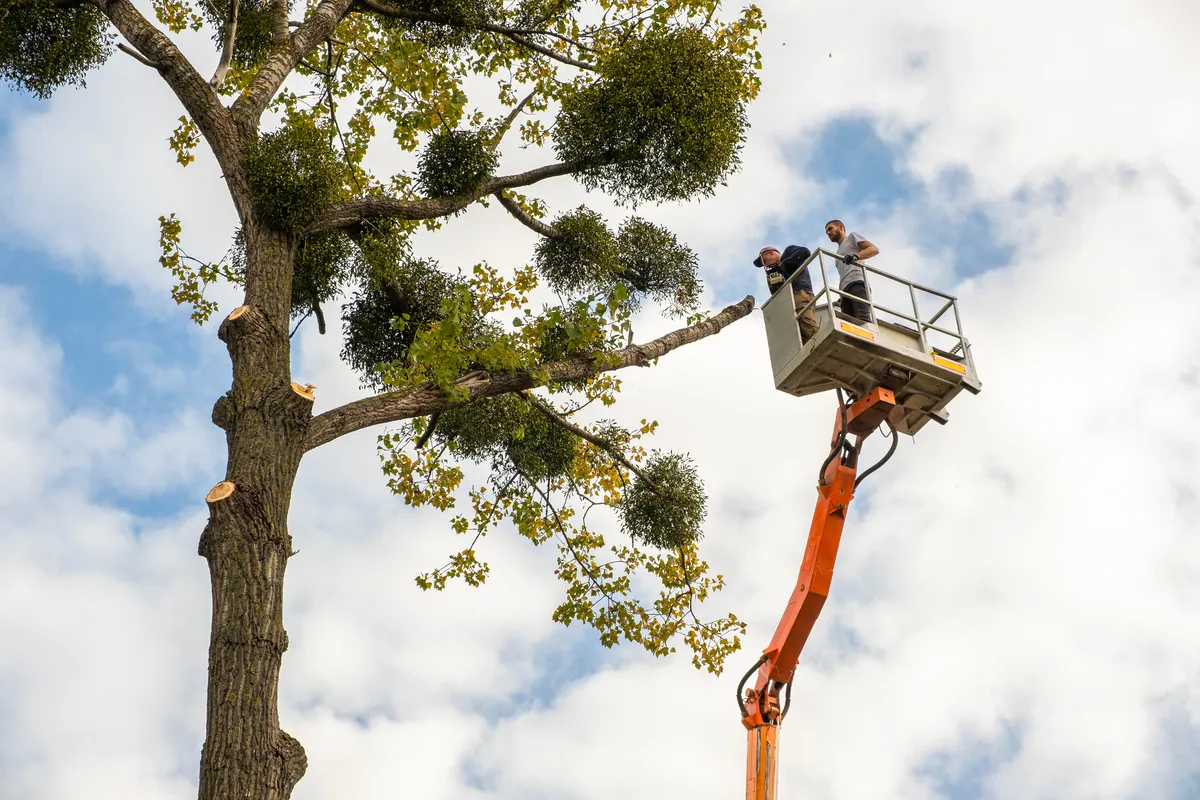
A dead tree that has been standing for several years may be structurally unsafe to climb at all. The crew may need to disassemble it entirely from a crane or bucket truck, which is the most expensive removal method.
Removing a dying tree while it still has some structural integrity is safer, cheaper, and less likely to cause collateral damage to your property.
Getting a Second Opinion
If you are not sure whether your tree can be saved, get an assessment from a certified arborist. Not a salesperson — an arborist with ISA certification who will give you an honest evaluation.
A good arborist will tell you three things: what is wrong with the tree, whether treatment can fix it, and what the odds of success are. If the answer is that the disease is too advanced or the structural damage is too severe, a good arborist will tell you that honestly rather than selling you treatments that will not work.
Get two opinions if the first one surprises you. But be wary of any company that guarantees they can save a tree that another arborist said is too far gone. Trees do not come with guarantees.
Worried About a Declining Tree?
Get a free assessment from certified Charlotte arborists. Find out whether your tree can be treated or needs to come down safely.
Get a Free Quote