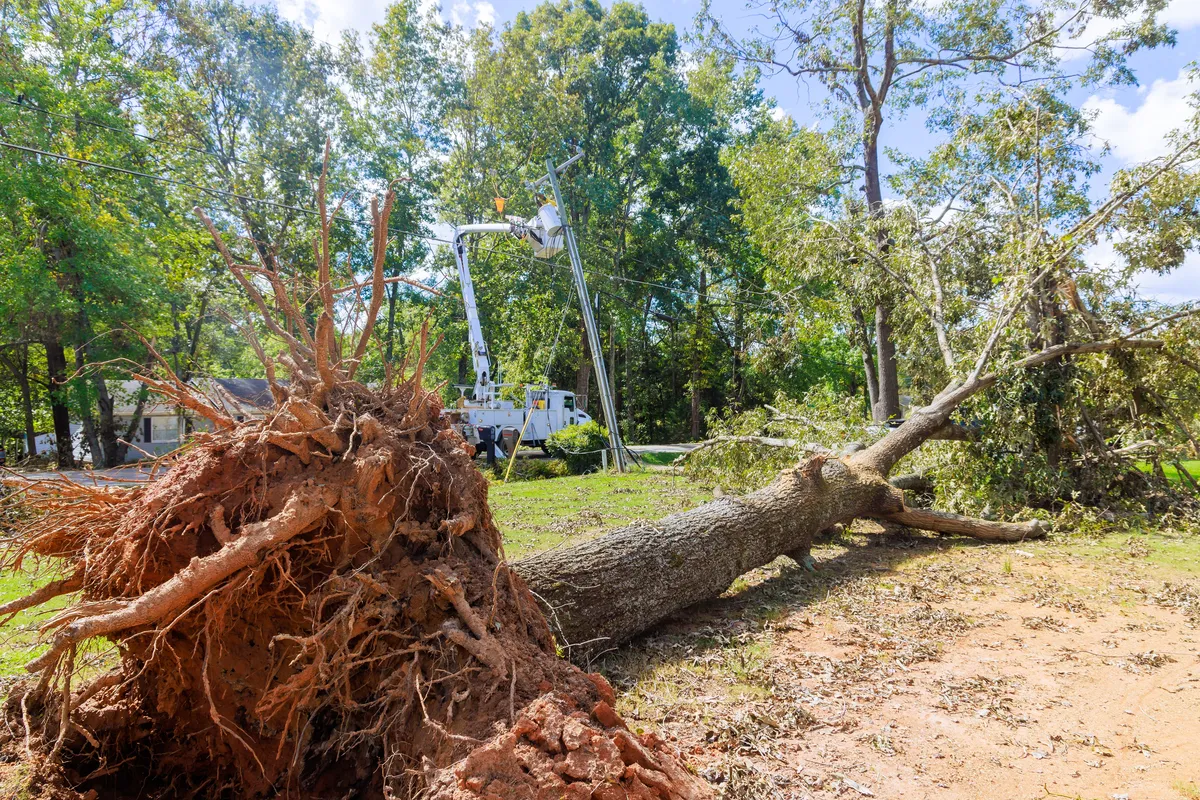
After every major storm in Charlotte, the same sight repeats across neighborhoods: trees split right down the middle. Two halves of what was a single canopy now splay outward like an open book, often with one half on the ground and the other leaning dangerously. It happens to big trees and small trees, oaks and maples, in front yards and along streets.
Tree splitting is not random. It follows patterns. The same structural weaknesses that existed before the storm are the ones that fail during the storm. If you know what those weaknesses look like, you can spot them in your trees before the next storm finds them for you.
The Number One Cause: Codominant Stems
The single most common reason trees split in Charlotte storms is codominant stems — two main trunks growing from the same point with a narrow angle between them. Instead of one central trunk, the tree has a V-shaped fork where two trunks of roughly equal size diverge.
The problem is the connection point. Where two stems meet at a narrow angle, the tree does not form a solid wood joint. Instead, bark gets trapped between the stems — arborists call this "included bark." Included bark is a weak spot. It does not hold the stems together; it actually prevents them from fusing properly. Under wind load, the stems pull apart at this weak joint.
You can spot codominant stems from the ground. Look for:
- A V-shaped fork where two trunks of similar size diverge from one point
- A dark crease or seam running down between the two stems — this is the included bark
- A slight bulge or swelling at the fork where the tree is trying to reinforce the weak connection
- Cracks or splits that have already started to open at the fork, even slightly
If a tree in your yard has codominant stems with included bark, it is at high risk for splitting. Cabling can reduce that risk by holding the stems together above the fork. Removing one of the two stems is another option, though it changes the tree's shape significantly.
Other Structural Weaknesses That Cause Splits
Dense, Top-Heavy Canopies
Trees that have never been pruned develop dense canopies that catch wind like a sail. When a gust hits, the full force transfers through the branches to the trunk and roots. If the wind load exceeds what the trunk can handle, the tree splits or snaps. Regular crown thinning — removing 10 to 15 percent of the interior branches — allows wind to pass through the canopy and reduces the chance of storm failure.
Internal Decay
Trees rot from the inside out. Fungi, bacteria, and insects gradually break down the heartwood, leaving the tree hollow or structurally weakened at the core while looking healthy on the outside. During a storm, these compromised trunks snap like tubes — the remaining shell of sound wood is too thin to resist the bending force of the wind.
You cannot always see internal decay from the outside, but some signs are visible: mushrooms or conks growing on the trunk, soft spots in the bark, cavities or holes, and sections of bark that sound hollow when you tap them. An arborist can use specialized tools to measure how much sound wood remains inside a suspect trunk.
Previous Storm Damage
A tree that suffered damage in a previous storm but was not properly repaired is much more likely to fail in the next one. Torn branches that were left with ragged stubs instead of clean cuts invite decay into the trunk. Cracks that started opening during one storm widen a little more with each subsequent event. A tree that "survived" a storm may have hidden structural damage that makes it a ticking clock.
Root Failure
Not all storm failures involve splitting. Some trees tip over entirely — the root plate lifts out of the ground and the whole tree goes down. This happens when the soil is saturated from heavy rain (which weakens root holds in clay soil) and then wind pushes on the canopy. The tree does not snap — it rotates around the base as the roots pull free from the mud.
Trees with compromised root systems — from construction damage, root cutting, compacted soil, or disease — are the most vulnerable. For more on how Charlotte storms damage trees, see our seasonal storm guide.
The Species That Split Most in Charlotte
Bradford pear. The poster child for storm failure in Charlotte. Bradford pears grow with multiple codominant stems packed into a tight, upright form. The branch angles are extremely narrow, included bark is everywhere, and the wood is weak. A mature Bradford pear in Charlotte has close to a 100 percent chance of splitting during its lifetime. It is not a question of if but when.
Water oak. Fast-growing with soft wood and a tendency to develop codominant stems. Water oaks also tend to hold dead branches in the canopy, which break free during storms.
Silver maple. Grows fast, develops multiple stems, and has brittle wood. Silver maples split more easily than most hardwoods.
Sweetgum. Moderately brittle wood combined with fast growth and a dense canopy. Sweetgums commonly lose large branches or split at major fork points during storms.
Red maple. Better than silver maple, but red maples still develop codominant stems frequently and can split in storms. They are less brittle overall but not immune.
By contrast, trees like white oak, hickory, bald cypress, and live oak have strong wood and naturally develop a single dominant trunk. They are the least likely to split in storms.
How to Prevent Splitting
Have your trees inspected. A certified arborist can identify codominant stems, included bark, internal decay, and other structural weaknesses that put trees at risk. An inspection before storm season gives you time to address problems. Most arborists charge $100 to $300 for a property-wide tree assessment.
Install cables on vulnerable trees. Cabling connects codominant stems with a steel cable high in the canopy, preventing them from spreading apart in wind. It is not a permanent fix — cables need to be inspected and replaced every 7 to 10 years — but it can keep a valuable tree intact through storms that would otherwise split it.
Thin the canopy regularly. Crown thinning every 3 to 5 years reduces wind load. It is the single most effective maintenance practice for storm resistance. A tree with a properly thinned canopy handles 60 mph winds far better than a dense, untouched canopy.
Remove deadwood. Dead branches in the canopy are the first things to break in a storm. Regular deadwood removal keeps those branches from becoming projectiles. It also protects your home from falling branches during thunderstorms.
Remove high-risk trees before they fail. If a large tree has severe codominant stems with included bark, significant internal decay, and is positioned where failure would hit your house, car, or neighbor's property, planned removal is safer and cheaper than emergency removal after a storm. A planned removal might cost $1,500 to $3,000. An emergency removal of the same tree after it has fallen on a structure can cost $5,000 to $10,000 or more.
What to Do If Your Tree Has Already Split
If a storm has already split your tree, the question is whether it can be saved or needs to come down:
Minor splits (less than 25 percent of the trunk): A tree with a small split or a single lost branch can often recover with proper pruning to clean up the wound. An arborist can evaluate whether the remaining structure is sound.
Major splits (more than 50 percent of the trunk): A tree that has split down the middle is almost always a removal. Even if both halves are still attached, the structural connection is destroyed. Bolting or cabling a major split back together is like gluing a broken bone — it does not restore strength.
Trees under tension: A split tree with one half resting on a fence, another tree, or a structure is dangerous. The wood is under enormous stress and can snap unpredictably. Do not try to deal with a split tree that is leaning against something. Call an emergency tree service and let professionals handle it.
Charlotte's storms will keep coming. The trees that survive them are the ones with strong structure, maintained canopies, and no hidden weaknesses. A pre-storm inspection and a little preventive pruning cost a fraction of what storm damage costs — and they keep your trees standing when the wind picks up.
Worried About Trees Splitting in Storms?
Get a free quote from experienced Charlotte tree service companies. A pre-storm inspection can identify weak points before the next big storm hits.
Get a Free Quote