Hickory does not get the attention that oaks and maples get. Most Charlotte homeowners can spot a willow oak or a red maple from across the street, but hickory tends to blend into the background — just another tall hardwood in a yard full of them. That changes the first time you try to have one removed and the tree crew quotes you 30 to 50 percent more than you expected.
Hickory wood is absurdly hard. Harder than white oak. Harder than maple. It dulls chainsaw chains faster than almost any other tree in the Charlotte area, and that hardness drives up every cost associated with cutting, splitting, and grinding it. If you have a hickory on your property, here is what you need to know.
Hickory Species You Will Find in Charlotte
There are several hickory species native to the North Carolina Piedmont, and Charlotte sits right in the middle of their range. The three most common in residential yards are pignut, mockernut, and shagbark.
Pignut hickory (Carya glabra) is the most common hickory in Charlotte. It grows throughout the Piedmont on well-drained slopes and ridges, and it shows up frequently in older neighborhoods where natural forest was partially cleared for development. Pignut hickories reach 60 to 80 feet tall with a narrow, oval canopy. The bark is tight and furrowed — no shaggy strips. The nuts are small, round, and bitter. Squirrels eat them; humans do not.
Mockernut hickory (Carya tomentosa) is nearly as common as pignut in the Charlotte area. It is called mockernut because the nut has a thick shell that promises a big kernel but delivers almost nothing inside — the shell is 90 percent of the nut. Mockernuts grow to similar heights as pignut, 60 to 80 feet, but tend to have a broader, rounder canopy. The leaves are large — up to 20 inches long — with a distinctive fuzzy underside.
Shagbark hickory (Carya ovata) is the one most people can identify because of its bark. Long, loose strips of bark peel away from the trunk and curl outward, giving the tree a rough, shaggy look that is impossible to miss. Shagbark is less common in Charlotte proper than pignut or mockernut, but you find it more often in the northern suburbs — Huntersville, Cornelius, Davidson — especially on properties near creeks or in older wooded lots. Shagbark hickory produces the largest, sweetest nuts of the three. They are edible and actually taste good, though cracking the thick shells is a project.
All three species share the traits that make hickory both valuable and problematic: extremely hard wood, deep tap roots, slow growth, and heavy nut production. If you want to understand how hickory compares to other trees in the Charlotte area, our hardwood vs. softwood guide breaks down the differences.
The Hardest Wood in Your Yard
Hickory's claim to fame is its wood. On the Janka hardness scale — the standard measure of how resistant wood is to denting and wear — hickory scores 1,820 pounds-force. For comparison, white oak scores 1,360 and red maple about 950. Hickory is roughly 35 percent harder than oak and nearly twice as hard as maple.
This matters to homeowners in two ways. First, hickory is incredibly strong and flexible. Hickory handles are on axes, hammers, and tool handles precisely because the wood absorbs shock without breaking. A healthy hickory tree resists storm damage better than most species. The branches are tough, the trunk is dense, and the wood does not snap easily under wind load. While oaks lose major limbs in ice storms and sweetgums split apart in summer thunderstorms, hickory usually holds together.
Second — and this is the part that shows up on your bill — that same hardness makes hickory expensive to cut. Chainsaw chains dull two to three times faster on hickory than on pine or poplar. A tree crew removing a large hickory may go through several chains in a single job. The wood is heavy, too. A cubic foot of green hickory weighs about 63 pounds, compared to 50 pounds for oak and 35 pounds for pine. Everything about the job is slower: slower cutting, heavier lifts, more wear on equipment.
The Nut Drop Problem
Every fall, hickory trees drop nuts. Depending on the species, these range from marble-sized (pignut) to golf-ball-sized (shagbark and mockernut). The volume varies by year — hickory trees have mast years where nut production doubles or triples — but even in a light year, a mature hickory drops enough nuts to create problems.
Hickory nuts hit hard. They fall from 60 or 70 feet, and a mockernut or shagbark nut in its thick husk weighs enough to dent a car hood, crack a skylight, or leave a welt if it hits you. Homeowners with hickory trees over their driveways know the sound — that sharp crack of a nut hitting the roof of a car. Over a season, the dents add up.
The husks split open on impact and leave dark stains on concrete, pavers, and decks. The stains are tannic acid, the same compound in walnut husks, and they are difficult to remove from light-colored surfaces. Power washing helps but does not always get them out completely.
On the lawn, the nuts and husks need to be picked up before mowing. Running a mower over hickory nuts sounds like a machine gun and can throw chunks of shell at high speed. Most people end up hand-picking nuts or using a nut gatherer roller — the same tool sweetgum ball sufferers use.
Unlike sweetgum balls, though, hickory nuts attract wildlife. Squirrels go after them aggressively, which means more squirrel activity near your house, more digging in flower beds where squirrels bury nuts, and occasionally squirrels finding their way into attics while hunting for storage spots.
Slow Growth and Deep Roots
Hickory is a slow-growing tree. Where a willow oak or tulip poplar puts on 2 to 3 feet per year in Charlotte, hickory grows 12 to 18 inches annually. A hickory that is 40 feet tall may be 50 or 60 years old. This slow growth is part of why the wood is so dense — the tree puts on tight, narrow growth rings year after year.
For homeowners considering planting hickory as a shade tree, the slow growth is a real drawback. You will wait 20 to 30 years before a planted hickory provides real shade. Oaks, maples, and tulip poplars all get there faster.
Hickory develops a deep tap root — a single dominant root that grows straight down into the soil. In Charlotte's clay, this tap root may reach 6 to 10 feet deep on a mature tree. The tap root is part of what makes hickory so stable in storms, but it also makes transplanting nearly impossible once the tree is more than a few years old. You cannot dig up and move a hickory. Once it is planted, it is there for good.
The lateral root system is less aggressive than oak or sweetgum. Hickory does not typically lift sidewalks or crack foundations the way surface-rooting species do. The roots go deep rather than wide, which is one of the few maintenance advantages hickory offers.
Storm Resistance
If there is one thing hickory does better than almost any other tree in the Charlotte area, it is surviving storms. The combination of hard, flexible wood and deep roots makes hickory one of the last trees standing after a bad storm.
During Hurricane Hugo in 1989, many of Charlotte's hickory trees came through with minimal damage while oaks, pines, and sweetgums snapped and uprooted around them. The same pattern repeats in smaller storms — Charlotte's summer thunderstorms with 60 mph gusts and the occasional ice storm in January. Hickory bends rather than breaks, and the deep tap root holds it in place when saturated soil loosens the grip of shallower-rooted species.
This storm resistance is a legitimate reason to keep a healthy hickory tree, especially if it is positioned where a falling tree would hit your house. A hickory in that spot is far less likely to come down than a pine, sweetgum, or water oak in the same location.
Removal Challenges: Why Hickory Costs More
When a hickory tree does need to come down — whether it is dead, declining, too close to a structure, or just in the wrong spot — the job costs more than removing a comparable pine, poplar, or even oak. Here is why.
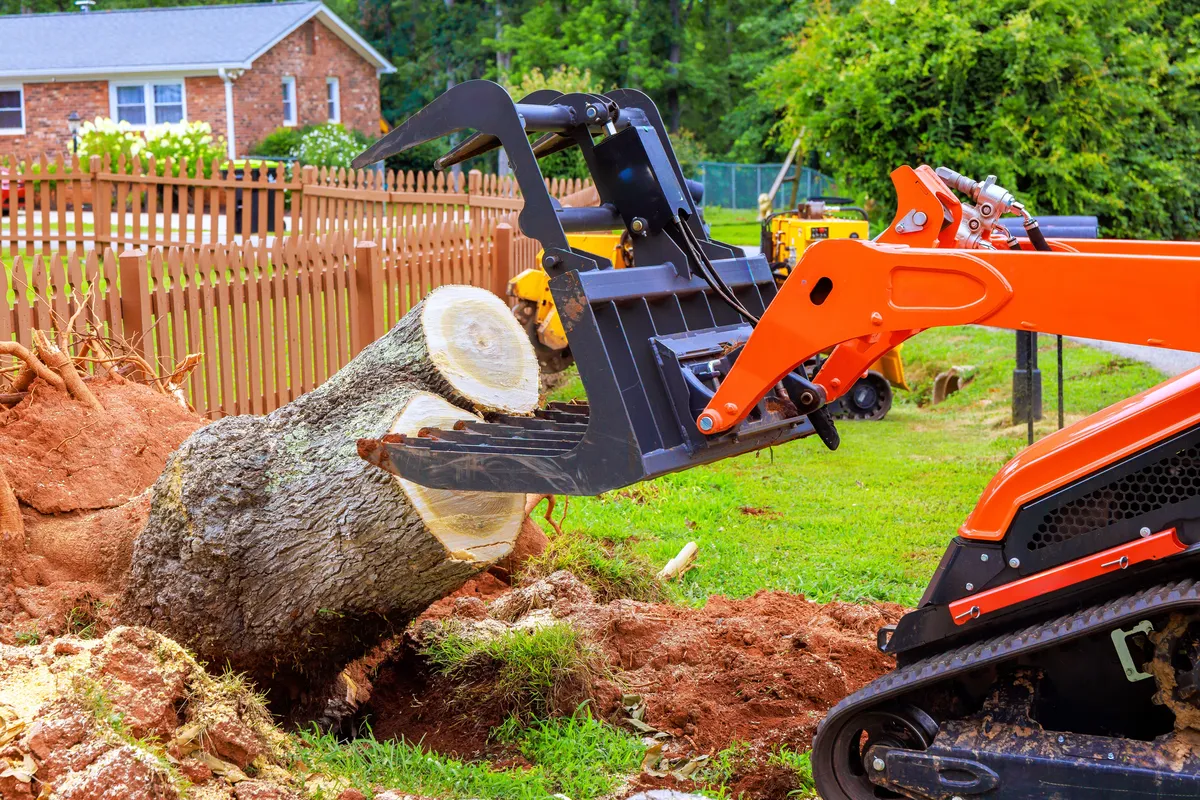
Chain wear. A tree crew cutting a 24-inch diameter hickory trunk will dull or destroy a chainsaw chain in the process. On a larger tree, they may go through two or three chains. Each chain costs $15 to $30, and the time spent swapping and sharpening adds to labor costs.
Weight. Hickory logs are heavy. A 3-foot section of a 20-inch diameter hickory trunk weighs over 400 pounds. Moving these pieces requires more crew members, heavier equipment, and more time. If the tree is in a back yard with limited access — no way to get a crane or grapple truck close — every piece has to be carried out by hand or with a wheelbarrow.
Rigging complexity. Because hickory is so heavy, rigging branches for a controlled lowering (common in tight spaces near houses) requires stronger ropes, larger pulleys, and more careful calculations. The margin for error shrinks when every branch section weighs 50 percent more than the same branch on a pine.
A typical hickory removal in the Charlotte area costs $1,000 to $4,000, depending on tree size, location, and access. That is 20 to 50 percent more than a similar-sized pine or poplar and about 10 to 20 percent more than an oak. The added cost is almost entirely driven by the hardness and weight of the wood.
Grinding a Hickory Stump
The hardness problem does not end when the trunk is down. Stump grinding a hickory takes longer than grinding softer species, and the teeth on the grinder wear down faster. A hickory stump that would take 30 minutes if it were pine can take 60 to 90 minutes.
Most stump grinding companies in Charlotte charge a flat rate based on stump diameter, and they build the extra time for hardwood stumps into their pricing. Expect $200 to $500 for a hickory stump, compared to $150 to $350 for a pine stump of the same size. If you are having the tree removed and the stump ground at the same time, many companies offer a package discount.
The tap root adds another wrinkle. Even after the stump is ground out 6 to 8 inches below grade — the standard depth — the tap root continues straight down. It will decay on its own over several years, but in the short term you may notice a soft spot in the ground where the tap root channel collapses as the wood breaks down.
When to Keep a Hickory
Despite the nut drop and the removal costs, hickory is a good tree in the right situation. Keep it if:
- The tree is healthy, well-shaped, and in a spot where falling nuts are not hitting cars, roofs, or walkways
- The tree is positioned where its storm resistance is protecting your house — between the house and the direction of prevailing storm winds
- You have a large lot where the nut drop falls on lawn or natural areas rather than hard surfaces
- You appreciate the wildlife — hickory nuts draw woodpeckers, squirrels, wild turkeys, and other native animals
A healthy hickory has a long life span. Many of the hickories in Charlotte's older neighborhoods are 80 to 120 years old and still going strong. If yours is in good shape, it may outlast you and the next two owners of your house.
When to Remove a Hickory
Removal makes sense when:
- The tree is directly over your driveway, deck, or roof and the nut drop is causing damage
- The tree is dead or in serious decline — dead branches, peeling bark (not the natural shaggy bark of shagbark hickory), fungal conks on the trunk
- You are clearing for construction and the hickory is in the building footprint — moving it is not an option given the tap root
- The tree is too large for the space and trimming cannot reduce its impact enough
If you are not sure whether your hickory needs attention, an arborist can assess its health, structural integrity, and risk level. For a tree this long-lived and storm-resistant, a professional opinion is worth the $150 to $300 consultation fee before you commit to removal.
The Bottom Line on Hickory
Hickory trees are tough in every sense of the word. They are tough enough to shrug off storms that flatten other trees. They are tough enough to dull professional chainsaw chains. And they are tough enough to create real headaches when the nuts start falling on your car every October.
If you have a healthy hickory in a good location, it is one of the strongest, most durable trees you can have on a Charlotte property. If you have a hickory in a bad spot — over the driveway, too close to the house, dead or dying — do not put off dealing with it. The longer you wait, the bigger it gets, and the more expensive the removal becomes. Hickory does not do anything fast, but it does not stop growing either.
Need Help with a Hickory Tree?
Get a free quote from experienced Charlotte tree service companies. Whether you need removal, trimming, stump grinding, or a professional assessment, get matched with licensed, insured professionals.
Get a Free Quote