There is a point where too much shade becomes a problem. Your grass thins out and turns into bare dirt. Moss takes over the north side of the yard. The garden beds that used to bloom stop producing because they barely get two hours of direct sun. The house feels dark inside. The roof stays damp longer after rain, and algae or mildew starts showing up on the shingles.
This is what happens when mature tree canopies close in and block most of the sunlight from reaching the ground. It is a common situation in Charlotte's older neighborhoods — Dilworth, Myers Park, Plaza Midwood, NoDa — where trees planted 40 to 60 years ago have grown into massive canopy cover. The shade was welcome when the trees were younger. Now it is suffocating everything underneath.
Canopy thinning is the solution. It is a specific type of pruning that selectively removes interior branches to let more light through the canopy without changing the tree's overall shape or size. Done correctly, the tree looks natural, stays healthy, and your yard gets the sunlight it needs.
What Canopy Thinning Is (and Is Not)
Canopy thinning is not topping. It is not hat-racking. It is not hacking off the bottom half of the branches. These butchering techniques — which still happen in Charlotte despite every arborist advising against them — damage the tree, create hazardous regrowth, and look terrible.
Proper canopy thinning removes select branches throughout the interior of the crown. The arborist targets:
- Crossing branches that rub against each other
- Water sprouts — those fast-growing vertical shoots that cluster along major limbs
- Dead or dying branches
- Crowded interior growth that blocks air and light
- Duplicate branches — two limbs growing in the same direction when one will do
The goal is to remove 15 to 25 percent of the live canopy. This opens up enough space for sunlight and air to pass through without stressing the tree. Removing more than 25 percent in a single season puts too much stress on the tree and can trigger a burst of weak, fast regrowth that defeats the whole purpose.
For more on the differences between pruning approaches, see our article on tree trimming vs. pruning.
Signs You Need Canopy Thinning
Not every large tree needs thinning. But if you are seeing these problems, the canopy is probably too dense:
Your Lawn Is Dying
Grass needs at least 4 to 6 hours of direct sunlight per day to survive. Fescue — Charlotte's most common lawn grass — tolerates partial shade but not deep shade. If your lawn is thinning out, going bare, or being replaced by moss and weeds, the canopy may be blocking too much light. You can reseed with shade-tolerant varieties, but if the canopy is dense enough, no grass will grow.
Moss and Algae Buildup
Moss on the ground is an indicator of deep shade and constant moisture. Algae or mildew on your roof, siding, or deck is a sign that those surfaces are not drying properly because the canopy holds in moisture and blocks the sun that would dry them out. This is not just a cosmetic issue — constant moisture accelerates rot on wood structures and shortens the life of roofing materials.
Garden Beds Are Failing
Plants that grew well five years ago are now struggling because the tree canopy has expanded. Most flowering plants need 6 or more hours of sun. Even shade-tolerant plants like hostas and ferns have light minimums. If your gardens are underperforming, look up — the answer is usually overhead.
The House Feels Dark
When canopy branches hang over the roof and extend past the eaves, they block light from entering windows. You end up using artificial light during the day in rooms that used to be bright. This also blocks passive solar heating in winter, increasing your energy costs.
You Can See Dense Interior Growth
A healthy, well-maintained tree canopy should not look like a solid mass. If you look up into the canopy and cannot see any sky through the branches, the interior growth is too dense. This density also makes the tree more susceptible to storm damage — wind cannot pass through a dense canopy the way it can through an open one, so the tree catches wind like a sail.
How the Work Gets Done
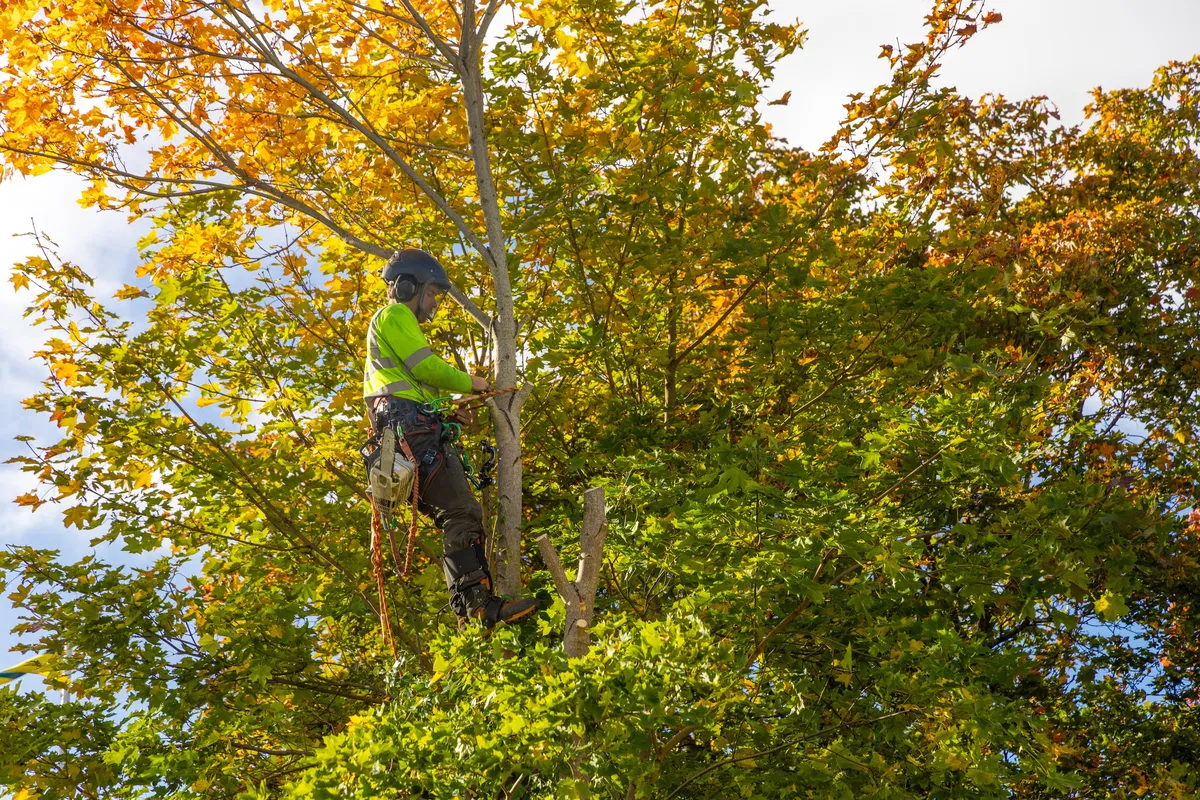
Canopy thinning on large trees is not a DIY job. The work happens 30 to 60 feet above the ground and requires climbing, rigging, and the ability to evaluate branch structure from inside the canopy. Here is what a professional crew typically does:
Assessment from the ground. Before anyone climbs, the crew lead walks around the tree and identifies the goals — where more light is needed, which branches are problematic, and how much thinning is appropriate for this species and this tree. An arborist consultation before the work starts is worth the cost, especially for large or valuable trees.
Climbing or bucket truck. The climber enters the canopy and works from the inside out. Each cut is made at a branch collar — the swollen area where the branch meets the parent limb. This is called a proper pruning cut, and it allows the tree to seal the wound naturally. No stubs, no flush cuts against the trunk.
Selective removal. The climber removes the targeted branches, lowering large pieces with ropes to avoid damage to the landscape below. The work moves through the canopy methodically — inside to outside, bottom to top. A good crew steps back regularly to check the overall look and balance.
Cleanup. All cut branches are chipped on site or hauled away. The ground is raked clean. A quality crew leaves no evidence they were there except more light coming through.
The Best Time for Canopy Thinning in Charlotte
Late fall through early spring — November through February — is the ideal window for canopy thinning in the Charlotte area. The best time to trim deciduous trees is during dormancy, when the tree is not actively growing. With the leaves off, the crew can see the branch structure clearly, identify problems easily, and make better decisions about what to remove.
Thinning can be done during the growing season if needed — for example, if storm damage exposed a thinning need or if a summer sale of the home makes it urgent — but dormant-season work is easier on the tree and usually costs less because the crew can work faster with bare branches.
Avoid heavy pruning in spring when the tree is pushing new growth, and avoid late summer through early fall when trees are storing energy for winter. Both of these timing mistakes can weaken the tree going into the next season.
Cost of Canopy Thinning in Charlotte
Canopy thinning is skilled work, and it is priced accordingly. For Charlotte-area trees, expect to pay:
- Small trees (under 30 feet): $200 to $600
- Medium trees (30 to 50 feet): $400 to $1,200
- Large trees (50 to 80 feet): $800 to $2,500
- Very large trees (80+ feet): $1,500 to $4,000+
Factors that affect the price include access (can the crew get a bucket truck close?), the number of trees, the species (hardwoods take longer than pines), and the density of the existing canopy. Getting quotes from multiple companies is smart — but be wary of anyone who quotes dramatically less than others. Low prices often mean aggressive cutting and poor technique.
Species-Specific Notes for Charlotte Trees
Willow oak. The most commonly thinned tree in Charlotte. Willow oaks grow dense canopies naturally and respond well to thinning. They can be thinned every 3 to 5 years to maintain good light penetration.
Red maple. Maples have softer wood and bleed sap heavily if pruned in late winter. Thin red maples in late fall or wait until full leaf-out in late spring.
Loblolly pine. Pines do not respond to thinning the way deciduous trees do. You cannot thin a pine canopy and expect it to fill back in — removed branches are gone permanently. Pine canopy work is more about removing dead lower branches (called limbing up) than interior thinning.
Crepe myrtle. Charlotte's most over-pruned tree. Crepe myrtles rarely need thinning. If yours is too dense, selective removal of a few interior branches is all that is needed. Do not "crepe murder" it by cutting all the branches back to stubs.
What to Expect After Thinning
The difference is immediate and noticeable. More light reaches the ground. Dappled sunlight moves across the yard instead of solid shade. Grass starts recovering within a few weeks during the growing season. The house feels brighter. The roof and decks dry faster.
The tree itself benefits too. Better air circulation through the canopy reduces fungal problems. Less wind resistance means less storm damage — a properly thinned canopy lets wind pass through instead of catching it. And the remaining branches get more light, which keeps them healthier.
You will need to thin again in 3 to 5 years as the canopy fills back in. This is normal — it is maintenance, not a one-time fix. Think of it like getting a haircut. The tree keeps growing, and periodic thinning keeps it in good shape.
Thinning vs. Raising vs. Reduction
These are three different pruning techniques, and they address different problems:
Thinning removes interior branches to let more light through the canopy. Use it when the canopy is too dense but you like the overall size and shape.
Raising removes lower branches to create more clearance underneath the tree. Use it when branches are too low — blocking the driveway, scraping the roof, or making it hard to walk under the tree.
Reduction shortens the overall canopy by cutting branches back to lateral limbs. Use it when the tree is too tall or too wide — growing into power lines, hanging over the roof, or encroaching on a neighbor's property.
Many jobs involve a combination. A tree might need its lower branches raised to clear the house, interior branches thinned for light, and a few long limbs reduced to keep them away from power lines. A good arborist will recommend the right combination for your situation rather than defaulting to one technique. Our guide on protecting your home from falling branches covers more about when these techniques matter most.
Need Canopy Thinning?
Get a free quote from experienced Charlotte tree service companies. Professional canopy thinning lets in more light while keeping your trees healthy and attractive.
Get a Free Quote